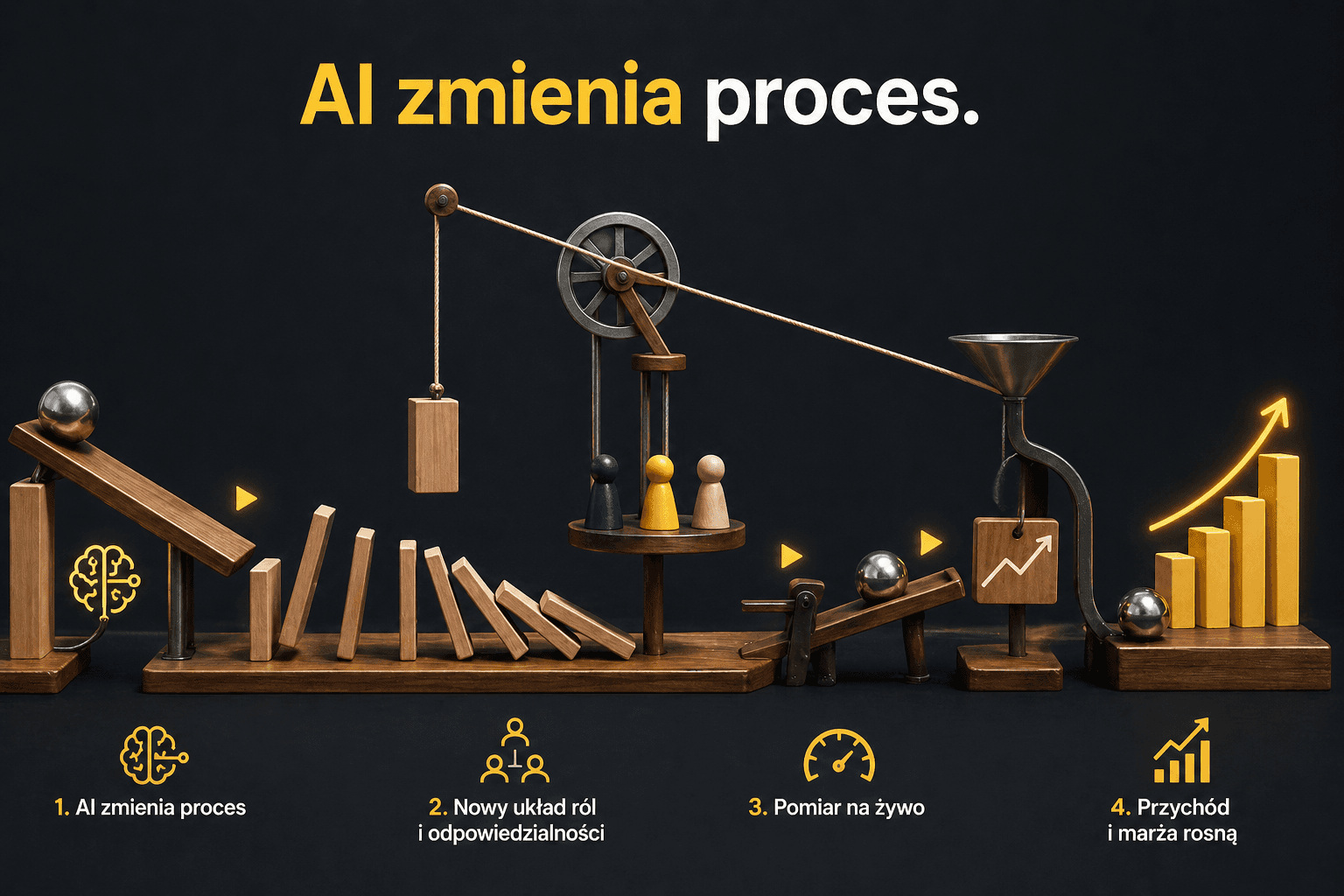
Chaque dirigeant et propriétaire de PME avec qui je parle a deux questions concrètes sur l'IA : comment baisser les coûts, ou comment augmenter le revenu et la marge. D'après mes observations – confirmées par des dizaines de conversations avec des dirigeants – ce sont les deux seules questions qui ont du sens dans une petite ou moyenne entreprise. Le reste du débat public sur l'IA est, pour le décideur PME, sans importance.
Pourquoi « ajouter de l'IA » ne baisse pas les coûts ni n'augmente le revenu
La plupart des tentatives d'introduction de l'IA en PME se ressemblent. Le dirigeant achète un outil, le distribue à l'équipe et attend les résultats. Quelques mois plus tard, il s'avère que les coûts n'ont pas baissé, le revenu n'a pas augmenté, et l'équipe est exactement aussi chargée qu'avant – mais avec des outils en plus. D'après mes observations, la raison est toujours la même. L'IA n'ajoute pas de valeur à un poste – l'IA décompose le poste en tâches, dont certaines cessent d'exiger une personne à plein temps. Tant que le dirigeant ne le voit pas et ne reconfigure pas la répartition du travail dans l'entreprise, les outils d'IA ne se traduiront ni par des coûts plus bas ni par un revenu plus élevé.
La guerre silencieuse de la juridiction – et pourquoi c'est le bon moment
Ce qui se passe vraiment dans une PME, c'est une guerre silencieuse de la juridiction – sur qui a le droit d'effectuer une tâche donnée. Le commercial avec IA commence à écrire des offres qui venaient auparavant du marketing. La spécialiste du service client avec IA analyse elle-même la rentabilité du client, qui relevait autrefois du contrôleur de gestion. L'opérateur avec IA documente un processus qui partait jadis chez un consultant externe. D'où la conclusion clé : c'est maintenant qu'il faut trancher cette guerre consciemment. D'abord, cartographier les processus qui génèrent réellement le revenu et la marge. Ensuite, réattribuer les tâches dans ces processus – en indiquant clairement qui fait quoi avec l'IA, qui contrôle le résultat et quelles parties du travail ne sont tout simplement plus nécessaires. Autrement dit – ranger la juridiction soi-même, avant qu'elle ne se range toute seule.
La mesure en direct comme base des décisions de coût et d'échelle
La cartographie et la réattribution n'ont de sens que si le dirigeant voit, en temps réel, comment la nouvelle organisation fonctionne. D'où la troisième étape, la plus souvent omise : intégrer une mesure dans chaque processus cartographié. Temps de traitement, coût unitaire, qualité du résultat, nombre de corrections humaines après l'IA. Sans cela, une décision de réduire les coûts ou de passer à l'échelle est un saut dans l'inconnu. Avec cela, elle devient une décision opérationnelle. Le dirigeant de PME ne regarde plus une fois par trimestre des résultats globaux – il voit en direct où l'organisation est rapide, où l'humain est le goulot d'étranglement, et où l'IA produit des erreurs. Donc si vous pensez à réduire les coûts ou à passer à l'échelle une PME avec l'IA sans mesurer les processus, vous mettez probablement le chaos à l'échelle ou vous coupez les coûts à l'aveugle.
Ma conclusion pour les dirigeants de PME
Ne demandez pas : « quel outil d'IA dois-je déployer ? ». Demandez plutôt : « ai-je cartographié les processus qui génèrent mon revenu, les tâches y sont-elles réattribuées à des personnes avec IA, et est-ce que je vois en direct comment cela fonctionne ? ». Car en PME, ce n'est pas celui qui achète l'IA le plus vite qui gagne. Gagne celui qui transforme le plus vite son entreprise en un organisme mesuré et pilotable – où la juridiction est claire, où les coûts peuvent être baissés consciemment, et où l'échelle devient une décision, non un espoir.
Chère lectrice, cher lecteur. Si vous dirigez une PME et souhaitez échanger avec moi sur la manière de cartographier vos processus, de réattribuer les tâches avec l'IA et de commencer à les mesurer en direct, contactez-moi.
Leszek Giza